Do brand mentions without links actually help SEO rankings?
Unlinked brand mentions, also called implied links, can support SEO performance even though they do not pass PageRank directly. They help search engines identify your brand as an entity, which plays a growing role in rankings. When repeated in trustworthy and relevant sources, they contribute to topical authority and support your existing link profile.
Implied links also support entity recognition, which is central to how Google evaluates brands within its Knowledge Graph. This type of off page signal strengthens brand credibility, especially in competitive search categories.
Here's What We Have Covered In This Article
What are implied links and how are they different from backlinks?
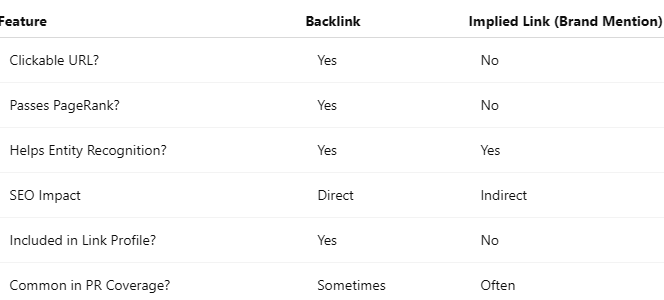
Implied links are references to your brand name or product on third party websites without an actual hyperlink. Traditional backlinks include a clickable link that directs to your site. Both forms of reference can signal authority, but only backlinks pass PageRank.
When implied links appear on trusted domains that match your niche, they help reinforce your citation signals and build visibility. They are not counted as part of your backlink profile but may help search engines connect your brand to specific topics.
How does Google use brand mentions as SEO signals?
Brand mentions allow Google to better understand entities and how they relate to topics. These mentions show up in blogs, media articles, interviews or directories. When paired with topical keywords, they help shape your brand's relevance in search.
For example, if a digital agency is repeatedly mentioned in business and tech publications, Google may begin associating the brand with terms like "SEO services" or "content marketing" This association improves your visibility for those search queries.
Google has filed patents outlining the use of implied links for ranking, and its representatives have spoken about how brand presence and context play a role in search. These mentions contribute to Google's entity based system for evaluating trust and authority.
Structured data and schema markup also support entity visibility by helping Google confirm relationships between your brand, topics, and mentions across the web.

Pro Tip : Mentions on high authority, relevant sites have far more SEO value than generic ones.
Boost Your Brand’s Authority
Want to turn brand mentions into actual results? See how our SEO strategies can help.
When do implied links help SEO and when do they not?
Implied links are most effective when they:
-
Appear on respected and relevant websites
-
Relate closely to your brand or industry
-
Reflect positive or neutral sentiment
-
Mention a distinct brand name
They offer less value when they:
-
Are published on low quality or off topic sites
-
Include negative sentiment or misleading context
-
Appear infrequently or without supporting signals
Earning mentions across several trusted sources reinforces brand trust and topical authority. These indirect signals support off page SEO by strengthening your relevance across the web.
Ethical ways to earn brand mentions without links
There are many practical ways to increase your brand mentions:
-
Share original research or data studies others may cite
-
Contribute expert opinions to journalist roundups
-
Speak on podcasts or take part in panel discussions
-
Comment on industry news or trending topics
-
Collaborate on articles or participate in interviews
Tools like BuzzStream and Mention.com make it easier to monitor where your brand appears. Alerts from Ahrefs can help spot new mentions you might ask to be turned into links. This method, known as link reclamation, works best when the content is already high quality.
Mention campaigns also support your digital PR strategy and help improve visibility across your sector.
How to track, measure and prove the value of brand mentions
While implied links do not directly increase PageRank, they still influence several measurable SEO indicators. You can:
-
Track branded search queries in Google Search Console
-
Use brand mention tracking tools such as Mention.com or Google Alerts
-
Monitor changes in referral traffic and visibility
-
Analyse topic alignment and sentiment using NLP platforms
You can also assess your online reputation and brand sentiment using social listening dashboards. Tools like BuzzSumo and SEMrush allow you to evaluate the impact of mentions on social shares, referral lift, and even follow up citations.
The more consistently your brand appears in industry content, the stronger your recognition becomes in search. This can help improve performance across high intent and informational keywords.

Pro Tip: Use brand monitoring tools to identify unlinked mentions you can reclaim as backlinks.
Need More Mentions from Trusted Sites?
Our digital PR team earns you mentions that actually move the needle in Google.