
How can you tell whether SEO is working if visible results are taking time?
You can tell by looking for movement in the right places before rankings or leads shift in a big way. Rising impressions, better click-through rates, stronger local visibility, improved enquiry quality, and more consistent presence in AI-driven search can all show that SEO is moving in the right direction, even if the headline numbers still feel quiet.
A lot of directors and managers know the feeling. Budget has gone in, pages have been improved, technical issues have been fixed, and yet the business does not seem to be flying up Google overnight. That gap between effort and visible return is where confidence often starts to wobble.
Here's What We Have Covered In This Article
Why SEO progress often feels invisible at first
SEO usually works with a delay. Search engines such as Google and Bing need time to crawl changes, process them, compare them with competing pages, and then decide how those changes affect rankings. Even after that, user behaviour can take longer to shift than expected.
Some work also creates value that is real but not instantly obvious. A technical fix may help crawling and indexing processes, but it may not produce an immediate traffic spike. A new service page may start appearing for long, specific searches before it earns visibility for broader terms.
Early delays often come from a mix of factors:
- Search engine algorithms need time to reassess pages after changes.
- Indexing processes do not always happen straight away, especially on lower-authority sites.
- Content-led growth tends to build gradually as pages earn relevance and trust.
- Competitors are changing their sites too, which means that progress is relative, not isolated.
A simple way to think about SEO timeframes is to separate infrastructure from visibility. Fixing redirects, page speed issues, metadata, internal links, or crawl problems is similar to improving the foundations of a building. The benefits matter, but they are often indirect at first. Content, authority signals, and search demand then shape how much of that value becomes visible in traffic and enquiries.
Patience matters, but blind patience does not. If there is no sign of search engine changes being recognised after a reasonable period, that may point to a more detailed issue than normal ranking delays.
Identifying the right signals: what to track beyond rankings
Rankings matter, but they are an incomplete measure of SEO performance metrics. A business can move from position 14 to position 9 for an important phrase and still see only modest traffic. Another site can hold a similar ranking profile but generate better leads because the page intent is stronger.
Looking beyond keyword rankings gives a more reliable picture of SEO tracking.
| Signal | What it can tell you |
|---|---|
| Impressions in Google Search Console | Your pages are appearing more often, even if clicks are still building |
| Click-through rate | Searchers are finding your listing more relevant or appealing |
| Organic landing page traffic | Individual pages may be gaining traction before sitewide growth is obvious |
| Engagement in Google Analytics | Visitors may be spending longer, viewing more pages, or converting more often |
| Google Maps and local pack visibility | Local intent searches may be improving separately from organic rankings |
| Presence in AI Overviews | Your content may be getting surfaced in newer search formats |
Traffic quality often says more than traffic volume. If a service business sees fewer visits but more relevant enquiries, stronger phone calls, or better-fit leads, that can be a healthier signal than a broad rise in low-intent traffic.
Google Search Console is especially useful for measuring SEO progress because it shows where visibility is improving before clicks fully follow. A page with climbing impressions and a steady rise in average position may still look quiet in commercial terms, yet it can be moving closer to the point where results become easier to notice. Local businesses also need to watch Google Maps separately, because map visibility can improve even when traditional organic listings remain fairly stable.

Practical SEO that supports your business – First Place SEO
Understanding the role of AI and generative search in modern SEO
Search no longer lives only in a list of blue links. A person may ask ChatGPT for provider suggestions, use Gemini for a quick summary, or rely on AI Overviews in Google before clicking through to any site at all. That shift changes how SEO results look and how they should be judged.
Traditional SEO and AI visibility overlap, but they are not identical.
- Traditional search often focuses on rankings, clicks, and page-level relevance.
- Generative search focuses more on whether a business or source is cited, summarised, or included in an answer.
- Conversational search often rewards clear structure, consistent business information, and content that answers practical questions directly.
If your business starts appearing in AI-generated summaries, that may be a meaningful sign of authority even before standard rankings improve dramatically. Structured data frameworks, clear page organisation, strong topical coverage, and accurate business details all support this kind of visibility.
Some agencies, including First Place SEO, have started treating Generative Engine Optimisation as a practical extension of SEO rather than a separate discipline. That perspective is useful because it reflects how people now gather information. Search behaviour is becoming more blended, with users moving between search engines, maps, answer engines, and AI tools during the same decision process.
A page that earns a modest number of clicks but gets repeatedly referenced in AI systems may still be doing valuable work for brand recognition and trust.

Pro Tip: Take note of rising impressions and improving enquiry quality, as these are reliable early indicators that your SEO strategy is starting to pay off.
Spotting early indicators of SEO momentum
Early SEO results rarely arrive as a single dramatic jump. More often, they appear as small signs that momentum is building under the surface.
Some of the most useful SEO progress indicators include:
- Higher impressions for service pages in Google Search Console
- More visibility for long-tail keywords with clear buying intent
- Increased branded search, which can suggest stronger awareness
- Better placement in Google Maps or the local pack
- More frequent mentions or citations in AI answer engines
- Improved lead quality, even if lead volume has not risen much yet
Long-tail movement is often one of the clearest early signs SEO is working. A plumber, solicitor, accountant, or surveyor may not rank quickly for a broad phrase, but they can begin to gain visits from more specific searches tied to location, service type, or urgency. Those searches usually bring fewer impressions, though they often bring better intent.
Branded search can also be revealing. If more people search for your company name after finding you through non-branded terms, local listings, or AI summaries, that suggests your visibility is starting to convert into recognition.
Another subtle marker is behaviour after the click. A page that keeps visitors reading, prompts them to view another service page, or leads them to a contact page more often than before may be improving in relevance. That change can arrive before rankings make a bigger leap.
Seen in isolation, each small gain can look unremarkable. Taken together, they often show the flywheel beginning to turn.

SEO Appointments for small businesses – First Place SEO
Common pitfalls: misreading data and losing confidence
Slow progress can be frustrating, and frustration tends to distort judgement. That is where poor decisions often begin.
- Reacting to short-term swings A dip over a week or two does not automatically mean the strategy is failing. Rankings move, search demand changes, and reporting periods can create misleading snapshots. A service business with low search volume in a niche market may see natural volatility that looks worse than it is.
- Assuming one change caused one result A traffic rise after a page edit can be linked to that work, but it may also be influenced by seasonality trends, brand activity, market demand, or wider industry benchmarks. Correlation is easy to spot. Causation is much harder to prove.
- Ignoring external context School holidays, weather, public events, economic shifts, and local competition can all affect demand. A roofing company and an employment solicitor will not see the same patterns at the same time, even if both are doing solid SEO work.
- Changing direction too often Repeated rewrites, abrupt strategy changes, and constant agency switching can interrupt progress just as search engines are beginning to process improvements. Impatience can produce the very stagnation a business is trying to avoid.
Google Analytics and Search Console become far more useful when they are read over sensible periods. Month-on-month patterns can help, but quarter-on-quarter comparisons often give a steadier view for service firms. Perspective matters here because the wrong interpretation can turn normal volatility into unnecessary panic.

Pro Tip: Regularly review local pack and Maps performance separately from organic rankings, as improvements can appear in local visibility before sitewide traffic shifts.
When to reassess strategy: recognising genuine stagnation
Slow does not always mean wrong, but some situations do call for a hard review. If months have passed with little to no movement in impressions, no improvement in indexed pages, no local visibility gains, and no change in enquiry quality, the issue may be strategic rather than simply delayed.
A useful way to review SEO stagnation is to ask:
- Are the right pages targeting the right intent?
- Has Google indexed the key content properly?
- Are technical issues blocking crawling, rendering, or internal linking?
- Does the site show clear expertise and service relevance?
- Are competitors publishing stronger or more useful pages?
- Is local information consistent across the site and business profiles?
- Are reports measuring outcomes that matter to the business?
If the answer to several of those points is unclear, an SEO audit is usually more helpful than another round of superficial tweaks. Technical SEO tools can reveal crawl issues, indexing gaps, duplicate content, or weak site structure. Content review frameworks can then assess whether pages actually match what searchers want.
Leadership teams often benefit from treating reassessment as a structured review rather than a verdict on failure. First Place SEO, incidentally, tends to frame this kind of work around clarity, intent alignment, and durable visibility, which is a sensible way to avoid chasing noise. Sometimes the answer is to stay the course with better measurement. In other cases, the site needs sharper positioning, stronger content, or a more realistic local strategy.
True stagnation usually leaves a pattern, not a single bad month.
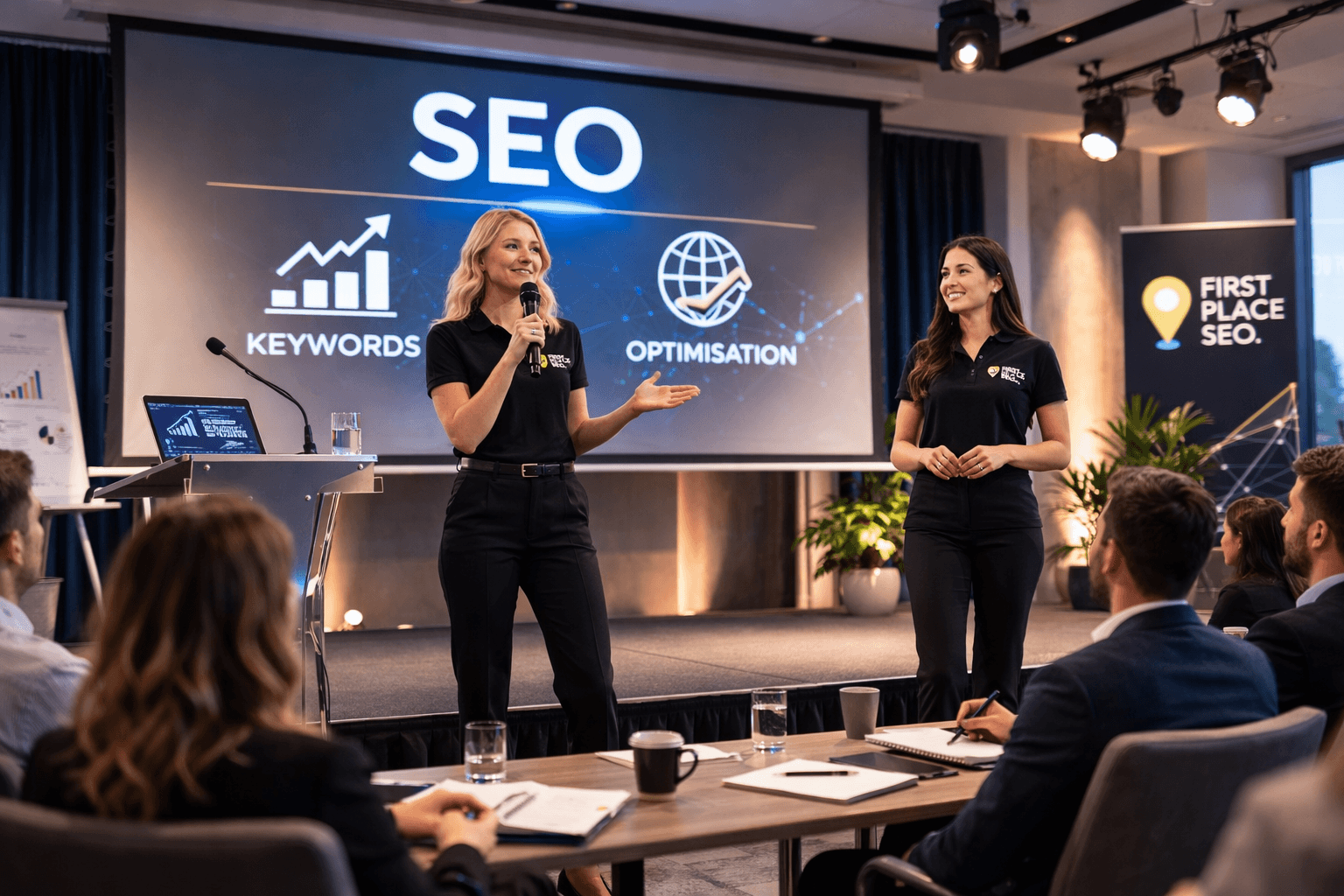
First Place SEO London Conference for SEO UK
The long view: why sustainable SEO outperforms quick fixes
Sustainable SEO often feels slow because it builds assets that keep working after the first burst of activity has passed. Strong service pages, clean technical structure, trustworthy local signals, and content that genuinely answers customer questions tend to accumulate value over time.
Quick fixes can create brief movement, particularly if they exploit a temporary gap or rely on tactics that push too hard against search engine guidelines. The problem is that short-lived gains rarely produce stable trust. Search engines keep reassessing quality, and users do the same with every click.
A steadier approach compounds in quieter ways. One page earns impressions, then clicks. Those clicks lead to branded searches. Branded searches support familiarity. Familiarity improves response rates when people see the business again in Maps, organic search, or an AI-generated answer. Bit by bit, visibility becomes easier to sustain.
That is why long-term SEO tends to reward consistency more than drama. In a search environment shaped by algorithms, local intent, and machine-generated summaries, the businesses that stay useful, clear, and credible are usually the ones that keep showing up.