
Why is my website getting traffic but no enquiries?
You might be getting plenty of visits, but if no one’s filling out forms or making contact, the issue is not just the volume. It’s about who’s landing on your site and what happens once they do. A spike in traffic looks great in analytics but means little if those visitors aren’t converting. Let’s unpack what might be happening and explain how to fix it.
Here's What We Have Covered In This Article
Why Website Traffic Isn’t Enough (And Why You’re Not Getting Enquiries)
Large numbers in Google Analytics can feel encouraging, but they don’t guarantee results. A steady stream of visitors won’t help if your site doesn’t convince them to stay or take action.
Some businesses assume visibility equals viability. If your content attracts the wrong audience, you will see engagement without meaningful outcomes. The goal is to draw in the right traffic, not just more of it.
Here are signs your traffic isn’t converting:
- Your service pages show high bounce rates.
- Users barely scroll before leaving.
- Forms remain untouched.
- You’re ranking for unrelated or low-intent keywords.
This mismatch often leads to what’s jokingly called “empty inbox syndrome.” Platforms like GA4 may show impressive figures, but insights from tools like Hotjar or HubSpot might reveal frustrated users who leave without engaging.
Rather than pushing for higher traffic, you should focus first on how to better connect with those already arriving.
Pro Tip: Always match your landing page content to the intent behind the keyword. That alignment makes or breaks conversions.
Fix Your SEO for More Enquiries
Not getting leads from your traffic? Let us audit your site and show you what’s going wrong.
5 SEO Mistakes That Attract the Wrong Visitors
Pulling in unqualified traffic can distort your data and dilute your message. It creates noise that prevents the right people from finding and trusting you. Here’s what might be going wrong:
High-Intent vs Low-Intent Keyword Examples
Understanding user intent is essential. Below are examples of SEO-related search terms, showing which ones typically lead to enquiries:
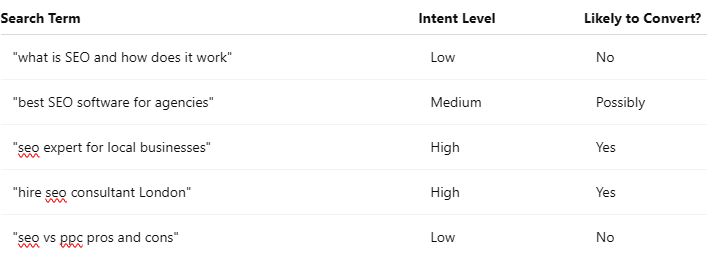
Knowing the difference helps you attract visitors who are actually looking to enquire.
1. Targeting low-intent keywords
Informational searches like “what is a meta description” don’t bring buyers. They bring browsers. Pages optimised for low intent search terms often generate ghost leads that never convert.
2. Focusing too heavily on blog content
Blogs can drive traffic but rarely convert. You should prioritise optimising your core service pages, where conversion-focused content belongs.
3. Ranking for unrelated search queries
Irrelevant traffic leads to poor lead quality. Use Google Search Console to assess which pages rank for mismatched intent.
4. Ignoring local and commercial modifiers
General terms attract general interest. “SEO services in Leeds” will always outperform vague keywords when it comes to enquiries. These commercial keywords are essential to drive enquiries from the right location.
5. Letting pages compete for the same keyword
Keyword cannibalisation weakens your site’s clarity. Tools like Surfer SEO help ensure each page has a clear and distinct target. Clean keyword separation supports effective landing page SEO and helps search engines assign topical relevance.

An AI photo of a First Place SEO advert in a London Street
Pro Tip: Set up conversion tracking in GA4 before changing anything else. You cannot improve what you are not measuring.
Book a Lead-Focused SEO Strategy Call
Stop guessing and start growing. We’ll show you exactly how to turn visits into real business.
How to Track What’s Working (and What’s Wasting Your Traffic)
Traffic alone means little if you cannot measure what’s turning visitors into leads. These methods help bring clarity:
Set conversion goals in GA4
Track actions like form submissions and click-to-call events. This is the only way to know what leads are coming from your website. Tag Manager can help refine these actions.
Tag your traffic sources
Use UTM parameters to understand which campaigns are driving real leads. Feed this data into your CRM for accurate attribution and lead tracking.
Spot weak points in your funnel
Use Hotjar, Clarity, or Matomo and GA4 to see where visitors drop off. These patterns reveal what needs improvement to reduce enquiry drop-off.
Focus on marketing-qualified leads
Monitor lead quality, not just volume. Tools like HubSpot or Zoho CRM can help score leads based on behaviour and source quality. It is the difference between volume tracking and actual lead attribution.
Reduce content that brings unqualified traffic
Review pages with high visits but zero conversions. Identify those attracting low intent search terms and adjust or remove them. Fixing unqualified traffic helps clean up your SEO funnel.
When to Bring in a Professional SEO Agency
DIY efforts can only take you so far. Knowing when to seek expert support can save time and boost performance.
Consider outside help if:
- You’ve made changes but leads haven’t improved.
- Technical SEO feels confusing or overwhelming.
- You can’t see what’s stopping conversions.
- You lack time to analyse data or run tests.
- You want results faster, not guesses.
A professional agency can deliver a full audit, action plan and tracking setup. At First Place SEO, we specialise in fixing enquiry drop-offs and aligning traffic with tangible results through lead path design and expert conversion review.
From Website Visits to Business Growth
Generating traffic is just the start. The real progress begins when that traffic converts into leads. A few precise fixes, better keyword targeting, sharper content, improved UX can turn an underperforming site into a consistent source of business.
Not sure what’s holding you back? Request a free strategy call or a quick audit of your lead-generating website. You could be one step away from real SEO results, without needing more traffic.