
Why are some service businesses getting more calls from Google than others?
Businesses usually get more calls from Google because they are easier for Google to trust, interpret and surface at the exact moment a searcher wants help. That usually comes down to stronger local visibility in Google Maps and the local pack, a better managed Google Business Profile, clearer reputation signals, and more consistent business information across the web. Organic rankings still matter, but direct call volume now depends much more on how well a business appears in local and AI-shaped search experiences.
A familiar pattern plays out every week. Two companies offer similar services in the same area, yet one phone rings far more often. The gap is rarely explained by chance.
Google now sends calls through several routes at once. A searcher may tap a click-to-call button in Google Maps, compare options in the local pack, or choose a business after reading a short summary on mobile search. In some cases, the website is barely part of the decision.
What Is In This Article
The shift in how Google drives calls to service businesses
Traditional rankings still have value, but they are no longer the only path to a phone enquiry. For many service businesses, the most important battle happens before someone reaches a website.
Several call pathways now matter most:
- Google Maps surfaces nearby businesses for immediate local discovery.
- The local pack gives searchers a short list with ratings, opening hours and direct call options.
- Google Business Profile often acts as the first impression and the decision point.
- AI Overviews and other AI-shaped results can influence which names feel credible at a glance.
- Mobile search shortens the path from query to call, especially for urgent services.
Search intent sits underneath all of this. If somebody searches for an emergency plumber on a mobile phone at 7pm, Google will usually prioritise fast, practical options. If another person searches for a family solicitor and spends time comparing reviews, the signals that matter may shift toward reputation, clarity and service relevance.
Many directors still assume that being number one in traditional organic results automatically brings the most Google call leads. In practice, local search calls often come from businesses that are simply easier to choose in the search result itself. A stronger Maps presence, better reviews or clearer categories can beat a higher website ranking.
Voice search and mobile behaviour have pushed this even further. Short, action-led searches often lead to quick comparisons and immediate click-to-call decisions, especially where speed matters more than detailed research. That pattern favours businesses that present clean, reliable signals right inside Google.
The role of Google Business Profile in call generation
A Google Business Profile now does much more than confirm that a company exists. In many local searches, it acts as the main sales window, trust marker and phone trigger all at once.
A high-performing profile usually gets the basics right first. Accurate opening hours, a correct phone number, the right primary category and a service description that matches what the business actually does are all central. If any of those are vague or wrong, Google has less confidence and the searcher has less reason to call.
Categories, services and attributes
Primary and secondary categories matter because they tell Google what type of searches the business should appear for. A competitor with a better chosen category set may be more visible for the exact service that drives the most valuable calls.
Attributes add context that can tip a decision. Service options, accessibility details, payment information and operational specifics all help a searcher decide quickly. On mobile, those details can matter as much as a polished homepage.
Reviews and recent activity
Review volume matters, but relevance and freshness carry weight too. A profile with recent feedback about a specific service often looks more dependable than one with older, broader praise.
Regular updates also signal that the profile is active. Posts, new photos, updated service details and owner replies all show that someone is paying attention. A neglected profile can look inactive even when the business itself is busy.
Q&A and completeness
The Q&A area is often overlooked. Yet it can answer practical concerns that stop a searcher from calling, such as service areas, availability or job types covered.
Profile completeness also affects confidence. If one listing includes services, categories, photos, reviews, business hours and clear service areas, and another looks half-finished, the difference is obvious before the searcher reads a single webpage.
Common pitfalls often include:
- using the wrong primary category
- leaving service details vague
- allowing outdated hours or phone numbers to remain live
- ignoring questions and review replies
- treating the profile as a one-off setup job
Competitors who get more Google Maps calls are often managing these details better, even if their wider marketing looks unremarkable.
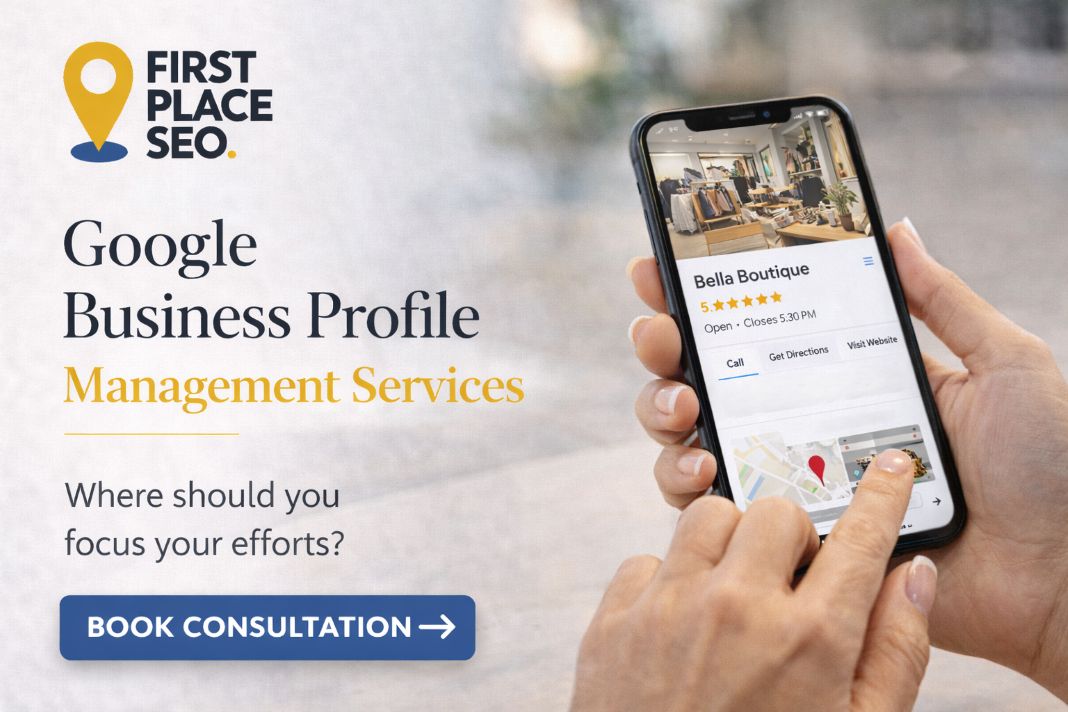
Google business profile management services for local uk businesses
Local SEO signals: what Google really looks for
Local visibility tends to rest on three broad ideas: proximity, relevance and prominence. Google has referred to these principles for years, and they still offer the clearest way to understand why one business appears before another.
Proximity is straightforward. A nearby business has an advantage, especially for searches with urgent intent. That said, distance alone does not decide everything.
Relevance is about fit. Google wants to know whether the listing, website and supporting signals match the service being searched for. If a business profile is categorised clearly, the service pages are specific, and the service areas make sense, Google has a stronger basis for showing that company.
Prominence is where many gaps appear. Reviews, mentions across local directories, local links, brand recognition and general trust all contribute. A business does not need fame, but it does need believable local authority.
Myth and reality
- Myth: Adding more keywords to a business name will improve local business visibility. Reality: Manipulative naming can create problems, and clear legitimate branding is safer.
- Myth: Citations only matter if hundreds are built. Reality: Accurate local citations matter more than volume, especially for NAP consistency.
- Myth: A website and a Google Business Profile work separately. Reality: Google compares both, and mismatched information weakens trust.
- Myth: Service area optimisation means listing every town possible. Reality: Service areas need to reflect real coverage and service relevance.
NAP consistency remains one of the quieter local SEO signals. If a phone number, trading name or address format varies across key listings, Google receives mixed information. The damage is not usually dramatic in one moment, but the cumulative effect can blunt visibility over time.
Websites still play a supporting role here. A strong profile backed by weak local pages can struggle, particularly for non-brand searches. Likewise, a good website with poor local listing data may fail to convert visibility into service business calls. Both need to agree on who the business serves, where it operates and what it offers.

Pro Tip: Regularly update your Google Business Profile with accurate hours, services, and fresh photos to maintain trust and visibility.
Reviews and reputation shape who gets the call
Picture a searcher choosing between two electricians. One listing has a healthy stream of recent Google reviews that mention punctuality, tidy work and clear pricing. The other has a similar star rating but only a handful of older comments with little detail. Many people will call the first business before they even visit a website.
That decision is partly emotional, but it is also practical. Reviews reduce uncertainty. They show whether the company turns up, communicates well and handles the kind of job the searcher needs.
A few review factors carry particular weight:
- Recency shows that the business is active now, not just historically well regarded.
- Specificity gives searchers useful clues about services, locations and customer experience.
- Volume creates a stronger sense of social proof.
- Owner replies suggest professionalism and ongoing engagement.
Star rating still matters, but it is not the whole picture. A long list of natural, varied feedback often outperforms a perfect-looking score with little substance. Searchers read tone, detail and patterns. They want reassurance that the business is dependable in ordinary situations, not just exceptional ones.
Owner responses can strengthen that impression. A short, thoughtful reply to praise shows attentiveness. A calm answer to a complaint can show fairness and accountability. Review management is less about image polishing and more about visible business behaviour.
Google also surfaces review snippets directly in local results. Those fragments can influence a call in seconds, particularly on mobile. In that moment, customer feedback becomes part of the search result itself rather than a separate reputation layer.

Two people finding a local business with more local visibility
AI Overviews and generative search are changing local discovery
AI Overviews Google results are beginning to influence how people compare businesses, especially for research-led or mixed-intent searches. A person may still end up calling through Google Maps or a profile listing, but AI-generated summaries can shape which names feel trustworthy before the final click.
A simple way to think about this is to imagine Google acting like a fast briefing assistant. It scans available information, identifies patterns and presents a compressed answer. Businesses with clear, consistent and well-structured information are easier for that system to summarise.
Structured data on websites, clearly labelled services, readable location information and accurate profile details all help. So does consistency between the website, the business profile and third-party listings. If Google or another answer engine finds conflicting details, confidence drops.
Some firms still treat generative search visibility as something distant or experimental. That view is becoming harder to defend. Even where AI Overviews do not directly generate a call, they can influence shortlists, perceived credibility and brand recall.
Generative Engine Optimisation, often shortened to GEO, is essentially about making business information easier for AI systems to interpret, summarise and cite. First Place SEO has highlighted this shift in practical terms for service businesses, particularly where local intent and quick decision-making overlap. The point is not to chase novelty. The point is to present clean signals that work across both human search and machine-led discovery.
Businesses that communicate plainly tend to be better placed here. Clear headings, straightforward service descriptions, accurate local information and unambiguous contact details give AI systems less room for error and searchers less reason to hesitate.

Pro Tip: Monitor review recency and owner replies closely, as active engagement often signals reliability to both Google and potential customers.
Automation and consistency reduce avoidable visibility loss
Consistency sounds mundane, yet it often separates businesses that stay visible from those that drift. Profiles change, hours shift, services expand and reviews arrive at odd times. Without a process, local visibility becomes patchy.
Automation can help by reducing avoidable errors. It can support business profile updates, citation synchronisation, review monitoring and recurring checks for missing or outdated information. Human oversight still matters, but repetitive admin does not always need to be manual.
A simple comparison makes the benefit clearer:
- Manual management often means updates happen late, inconsistently or only after a problem is spotted.
- Automation-supported management makes it easier to keep core information aligned across platforms.
- Manual review tracking can miss patterns in customer feedback or leave replies waiting too long.
- Automated monitoring can flag new reviews promptly so someone can respond with context and judgement.
The main mistake is assuming automation replaces decision-making. It does not. Good systems act as a safety net for process consistency, not a substitute for business knowledge. They reduce friction, catch gaps and support ongoing optimisation.
That matters because small data errors can have outsized effects. A wrong phone number in one directory, old bank holiday hours, or a missing service update can quietly reduce trust and call volume. Prevention is usually less visible than recovery, but it pays off in steadier local search calls.
An illustrative photo of a business owner doing local seo sq
Why your competitors are getting more calls
In most cases, competitors are not winning because they found one trick that Google rewards. They are winning because more of their signals line up with how Google now surfaces local businesses.
Their advantage often looks like this:
- a more complete and active Google Business Profile
- stronger review recency and better owner engagement
- cleaner NAP consistency across listings
- clearer service relevance on both profile and website
- better alignment with mobile search, Google Maps and AI-shaped discovery
That edge is cumulative. One competitor may have better categories. Another may have fresher reviews. A third may simply keep its information accurate across every platform. None of that feels dramatic in isolation, yet together those details shape who gets seen, trusted and called.
Outdated habits still hold many firms back. Some still focus almost entirely on old-style rankings, ignore their profile after setup, or treat local SEO best practices as a one-off technical task. Google's local ranking framework now rewards businesses that stay coherent across every visible touchpoint.
A useful way to view local call generation is this: Google is trying to reduce uncertainty for the searcher. Businesses that make the decision easy tend to receive more of the calls. As search becomes more local, more mobile and more influenced by AI-driven search features, that principle is likely to matter even more.