

What is query fan‑out in AI search, and why does it matter?
Query fan-out describes how AI-powered search engines, such as Google SGE or OpenAI-based systems, break a single user question into a set of related sub-questions. Your content now needs to match these branching intent paths. Rather than chasing one phrase, you’re aiming to cover a connected web of ideas that improves your visibility in AI-generated SERPs.
Here's What We Have Covered In This Article
1. What Is Query Fan‑Out – And Why Should You Care?
Picture a customer typing “Do you sell jackets?” AI tools don’t just return jacket retailers. They expand that query: do they want waterproof or insulated jackets? What’s the budget? Which brands are they considering? Is it for cold weather? That’s query fan-out.
Search engines powered by large language models (LLMs) like Gemini, Microsoft Copilot, or BERT analyse the query and identify a set of sub-intents. These tools perform semantic retrieval to link questions with precise, contextual answers. Some even use RAG pipelines (retrieval-augmented generation) to match user intent to reliable source snippets.
In the past, search worked like a straight line: one question in, one result out. Now, it’s more like a constellation. Content that misses these deeper questions is unlikely to show up in AI snippets or passage-based rankings.
Some businesses still approach SEO as a keyword checklist. But fan-out means one query might hold ten directions. Think prism, not funnel. One beam of light, scattered into many.
Traditional SEO vs Query Fan-Out SEO
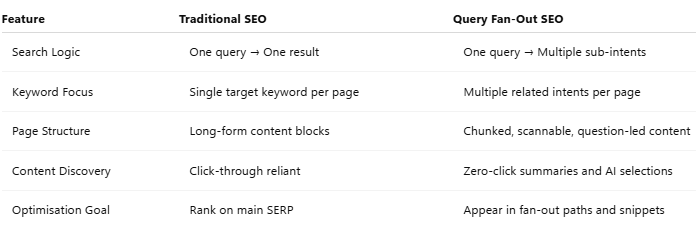
This shift changes how visibility works. Ranking on page one isn’t the endgame anymore. You want to appear in the micro-paths where AI is drawing answers from.
Pro Tip : Use real questions in headers to increase your chances of appearing in AI summaries.
Need Help Showing Up in Local Search?
If your map visibility dropped or AI is skipping you, we can fix it.
2. How Query Fan‑Out Impacts Your Website’s Visibility
Here’s the catch. When AI breaks a single question into smaller parts, will any of your content match what it needs?
Ranking for the surface-level keyword doesn’t guarantee a spot in the deeper sub-intents. AI-generated results often grab well-structured, clearly marked-up, or highly relevant snippets from multiple sources. If your page lacks those markers, you might be skipped over.
This particularly affects small businesses and local services. You might have quality content and strong reviews. But if answers are buried in dense paragraphs, AI can’t easily use them. Zero-click summaries prioritise fast clarity.
Creating more content isn’t a solution by itself. The goal is to write with intent – answering sub-questions in ways that AI can process. What matters is content positioning, trust signals, and being answer-ready.
And since AI now evaluates your site across multiple intents, fan-out readiness matters more than ever. Optimise not just for visibility, but for semantic discoverability in a multi-intent search environment.
3. Quick Self-Audit – Is Your Content Fan-Out Friendly?
You can run this audit right now – no special tools required. Use the checklist below to assess whether your content is aligned with multi-intent, AI-driven search:
Fan-Out Audit Checklist
Headings clearly reflect user questions or search-driven subtopics
FAQs are included to cover expected follow-up queries
Definitions and comparisons are easy to skim and structured clearly
Internal links connect logically to related services or supporting content
Multiple user intents are addressed on the same page, not just a single topic
Watch for: Dense paragraphs without breaks – these reduce your chances of being picked up in AI snippets. Use subheadings and bulleted formatting to make each intent easy to identify. AI prefers segmented, labelled answers.
This quick fan-out audit helps you catch blind spots in your AI search breakdown. Treat it as a content readiness check.
Give it structure: use subheadings, bullet points, and quick in-text explainers. Think of each section as a node in a multi-intent map. Make it easy to spot.
Pro Tip: Chunk content into clear, answer-ready sections using subheadings and FAQs.
Want to Rank in AI Overviews?
We’ll optimise your profile and content so you appear where customers are looking.