
What is a local entity home page and why does it matter for brand SERPs?
A local entity home page is the one page Google trusts as the main source of business information. It brings together all the essential details: business name, address, phone number, services, structure and trust signals. This page supports your appearance in the Knowledge Graph, Local Pack and featured snippets. If it is clear and well structured, Google is more likely to show your brand correctly in search results, even without a click.
Terms like entity home SEO, local entity SEO and entity source page all revolve around building one reliable page that acts as your online reference point.
Do I already have an entity home?
Q: How do I know if my website already has an entity home?
A: If your site has a single page that includes your business name, address, core services and structured data and this is referenced across your citations, it likely acts as your entity home. If the information is scattered across multiple pages or not consistent, you probably need to create or strengthen it.
Here's What We Have Covered In This Article
Why your brand SERPs are at risk in zero click search
When someone searches for your business, Google may display the answer without linking to your site. These are called zero click searches. Details in the knowledge panel, map pack or featured snippet can be pulled from directories or review sites.
If your site includes unclear or inconsistent facts, Google might pull the wrong data. A strong entity home gives the search engine one reliable page to reference.
By building an accurate entity home, you improve brand SERP optimisation and make it more likely that Google displays the right information whether someone clicks or not.
Which page should be your entity home?
Most businesses use their homepage, as long as it clearly states who they are, what they do and where they operate. If you manage a business with several branches, a central About page or location hub may work better.
The key is to choose one page and use it consistently. If you divide your identity between several pages, it becomes harder for Google to understand your brand. Keeping all signals focused on one location gives your business a stronger presence.
Think of your entity home like a front desk. It is where people and search engines get the right first impression.
If you run a multi location business
Use a single entity home that describes your business overall. Link your location pages from there. Each location can include its own LocalBusiness schema, but the main entity home should stay consistent across the site and other listings.
Key information every entity home page must include
Make your entity home complete and factual. It should include:
Business name, address and phone number (NAP)
Clear description of your business type and core services
Logo and relevant business or team images
Names of founders or key staff members (if applicable)
Links to social and review platforms using SameAs schema
Straightforward sections explaining who you are, what you do, and who you serve
Outbound links to trusted profiles like LinkedIn, Trustpilot and Yelp
Google uses this data to match up your business across the web. The more aligned and consistent these details are, the more confidently your brand appears in search. This is also essential for maintaining fact accuracy and supporting entity reconciliation.
Pro Tip : Use the SameAs property to link your site to trusted profiles like LinkedIn and Trustpilot.
Ready to Strengthen Your Brand SERP?
Let us help you build a fully verified entity home page that Google trusts.
How to use schema markup and structured data correctly
Structured data makes your content understandable to search engines. Use JSON LD to add schema markup to your entity home page.
Add
OrganizationorLocalBusinessschema with fields like name, website, address, logo and description.Include
SameAslinks to verified profiles such as LinkedIn and Trustpilot.Make sure your structured data matches the content users can see on the page.
Including disambiguation tags and validating your entity SEO schema ensures Google links the right data to the right business.
Here is an example of a simple LocalBusiness schema:
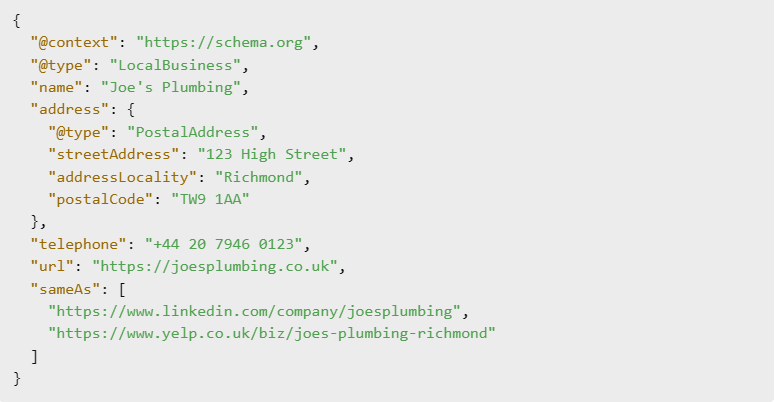
Pro Tip: Always test your structured data using Google’s Rich Results Test before publishing.
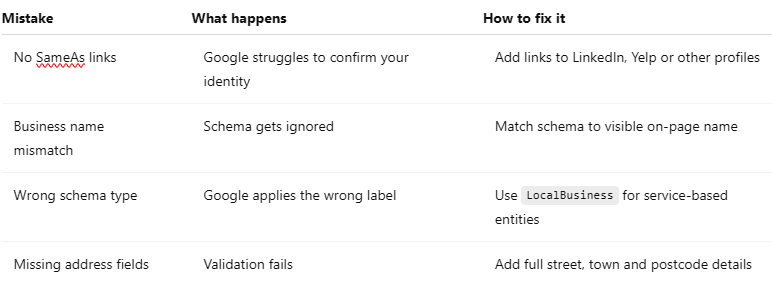
Confused About Schema Markup?
We implement LocalBusiness and Organization schema the right way so Google recognises your brand.