
Key points
- Entity SEO helps Google see your business as a real, verified brand.
- Add Organisation schema and link to trusted profiles with sameAs markup.
- Keep your name, address and phone number the same everywhere.
- Claim and complete your Google Business Profile.
In this article14 sectionsHideShow
What is Entity SEO and why does it help small businesses rank higher?
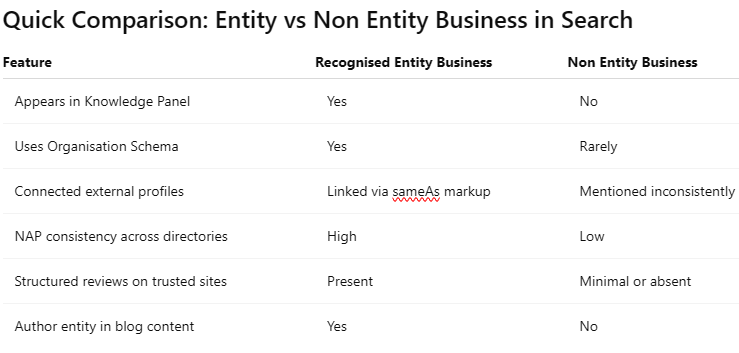
Entity SEO helps Google view your business as a recognised, verified identity rather than just a web domain. When your business is structured this way, it benefits from higher rankings, stronger visibility in knowledge panels, and better relevance in related searches. This makes it easier for potential customers to find and trust you.
Entity SEO connects your brand to the Google Knowledge Graph using structured signals like schema markup, consistent business citations, and trusted online references. These help search engines understand your business contextually, including who you are, what you offer, and how you relate to other verified identities and semantic entities.
1. Add organisation schema to your homepage
Organisation Schema is structured data you can add to your homepage. It helps Google identify key details about your business:
- Business name
- Logo
- Website URL
- Physical address
- Contact number
- Date founded
Adding this in JSON LD format supports entity recognition and connects your brand to topic associations in the Knowledge Graph.
2. Link to trusted profiles using sameAs markup
sameAs markup helps Google connect your site to trusted external references. These may include:
- Companies House
- LinkedIn company page
- Trustpilot
- Google Business Profile
- Social media accounts
This method strengthens your semantic business profile and improves consistency across your digital brand presence.
3. Create an about page that builds entity signals
Your About page is a key semantic trust indicator. Use it to outline:
- What your business offers
- Operational regions
- Team leadership and founding background
- Industry certifications or media recognition
This content forms the foundation of your verified identity and supports Google’s understanding of your topic relationships.
4. Use consistent NAP across all listings
NAP consistency, Name, Address, Phone, is one of the strongest search engine identity signals. Make sure your contact info is:
- Exactly matched across your website and all directories
- Present on platforms like Google Business Profile, Yell, Yelp UK, and Hotfrog
- Verified on key citation sources like GOV.UK
Consistency supports brand classification and local entity trust.
5. Get featured on trusted UK platforms
Trusted listings validate your semantic business identity. Target:
- Companies House
- GOV.UK Business Directory
- Yell
- Checkatrade
- Hotfrog
- Trustpilot
- Yelp UK
These external mentions confirm you as a recognised organisation with a credible presence in the UK business ecosystem.
6. Encourage verified reviews
Reviews with keywords and local references reinforce your reputation and entity trustworthiness. Request feedback on:
- Trustpilot
- Google Business Profile
- Reviews.co.uk
Encourage reviews to include what service was used, where, and by whom. This builds your online reputation signals and supports structured business profiling.
7. Use your brand name in page titles and H1s
Consistently include your brand name in:
- Homepage H1 and title tag
- Service page headers
- Meta descriptions
This approach links your brand to specific service areas and improves your position in knowledge based listings.
8. Establish an author entity for blog content
Create a recognisable author entity by:
- Using the same author name and profile photo on all posts
- Linking to an author archive with a bio and role
- Connecting that author to a verified LinkedIn account or professional page
This supports E E A T and helps search engines evaluate author trust signals.
9. Get mentioned on other trusted websites
Aim to be referenced on websites that are semantically relevant to your niche. Examples:
- Supplier websites
- Local business networks
- Trade associations
- Industry blogs
These mentions reinforce your digital brand consistency and serve as third party corroborations for your business identity.
10. Claim and optimise your Google Business Profile
To strengthen your search engine validation:
- Use accurate categories and descriptions
- Add photos, Q and A, and service highlights
- Keep opening hours and updates current
- Encourage keyword relevant reviews
Together, these reinforce your local semantic authority and brand prominence.
Other structured data types that help
Extend your schema beyond Organisation Schema to boost semantic indexing:
- LocalBusiness Schema for location based relevance
- Product Schema for ecommerce or physical goods
- Service Schema for defined offerings
- Review Schema for embedded rating signals
- FAQPage Schema to match “People Also Ask” queries
These reinforce topic clusters and help structure your search engine identity.
Free call
Want more enquiries from Google?
Book a free call and we'll look at your site with you, then show you what's holding it back.
How can you tell if Google recognises your business as an entity?
Search your business name and look for:
- Knowledge Panel or Brand SERP
- Structured snippets from your review platforms
- Grouped results showing your website, social accounts, and citations
To explore deeper:
- Use Kalicube Pro or InLinks Entity Checker
- Try Google API Explorer to assess Knowledge Graph presence
Recognition indicates you are seen as a classified and semantically connected brand.
UK specific trust platforms that help
To support Google’s understanding of your verified business identity, register with:
- Companies House
- GOV.UK Business Directory
- Yell
- Trustpilot
- Hotfrog
- Yelp UK
- Checkatrade
These act as national validation nodes and increase confidence in your brand’s legitimacy.
Entity SEO self assessment checklist
Use this checklist to assess whether your small business is well structured for entity SEO:
- Organisation Schema is implemented on your homepage using JSON LD
- sameAs markup links to all key profiles (Trustpilot, Companies House, LinkedIn, social media)
- Name, Address, and Phone number are identical across your website and directories
- You are listed on at least three trusted UK platforms (e.g. Yell, GOV.UK, Checkatrade)
- Google Business Profile is complete with services, photos, updates, and Q and A
- About page includes founding date, team details, service area, and internal links
- Customer reviews are verified and contain service and location keywords
- Blog content uses a consistent author with a bio and linked professional profile
- Your brand is mentioned on third party websites (partners, suppliers, industry blogs)
- Brand name appears in homepage H1 and across service page titles and meta descriptions
Frequently asked questions
Q: Can a small business appear in the Knowledge Graph?
Yes. By structuring your data properly, building semantic trust, and linking to authoritative platforms, even small businesses can be included.
Q: What is an entity home page?
This is the main webpage Google associates with your brand identity, typically your homepage or About page.
Q: Do I need backlinks to support my entity profile?
Not necessarily. While backlinks help, semantic citations, structured data, and digital brand consistency are just as important.
Q: How long does it take for Google to recognise my entity?
Timelines vary. With strong semantic signals, some businesses see results in weeks. Others may take several months, especially without structured references.
Need help building entity SEO?
We help UK small businesses strengthen their semantic presence and entity structure. From schema markup to review optimisation and citation audits, we build the foundation for trusted, verified digital identities.
[Start your free entity audit] or explore our [local SEO for small businesses] to learn how we support long term visibility and recognition in search.